 | |
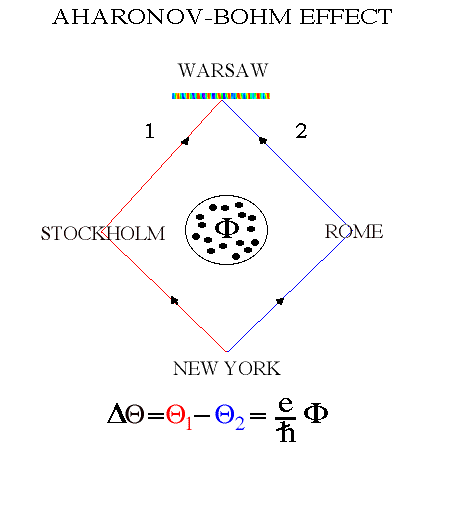
| Figure 1. The Aharonov-Bohm experiment. Electron moving along red path has a different phase than the one moving along the blue because of the magnetic flux represented by the dots inside the circle | |
Matt Kalinski (mkal@spanky.pas.rochester.e
du)
Department of Physics and Astronomy
University of
Rochester
Rochester, NY 14627
Popular Version of Paper N18.14
Monday morning, April 21,
1997 Joint APS/AAPT April Meeting,
Washington, DC
In 1959 Aharonov and Bohm made a remarkable discovery [1]: the quantum waves of particles can 'feel' space everywhere and 'know' the existence of magnetic fluxes 'telepathically'. This means that if one carries a quantum particle in an airplane from New York to Warsaw, flying once via Rome, and the second time via Stockholm, he can use the particle to detect the Eiffel tower in Paris if the tower is magnetized. This can be done by comparing the quantum phases gained by the particle during each trip. What is more, this can be done no matter how far one is from Paris on the way. This startling prediction by Aharonov and Bohm (AB) led to a long discussion in the physics community and finally was confirmed experimentally in delicate small-scale experiments with electrons. Fig 1. shows schematically a 'standard' AB experiment. An electron can be carried either along path 1 or path 2 and both paths draw a closed contour which encircles a bundle of magnetic flux - a magnetic field region that is confined far from both paths so the magnetic Lorentz force acting on the moving electron is negligible. If a screen is placed at the end of the paths an interference pattern will form as a result of the wave properties of the particles. The AB prediction is that the mere existence of the (remote) magnetic flux will shift the interference fringes by an amount directly proportional to this flux.
| | |
| Figure 1. The Aharonov-Bohm experiment. Electron moving along red path has a different phase than the one moving along the blue because of the magnetic flux represented by the dots inside the circle | |
Our discovery of well-localized quantum states of hydrogen, called Trojan states because of their celestial analog - the Trojan asteroids of the earth's solar system [2], is relevant to the AB effect because Trojan states open a new experimental domain for its observation. We predict that one can repeat an AB experiment on the scale of a single atom.
First we consider the hydrogen atom in a Trojan state in another way. We think of it as a small electric engine with a rotor consisting of a single electron. In the Trojan regime, the engine's power is supplied by an external circularly polarized electromagnetic field rotating with the same frequency as the electron in its Trojan orbit. When this engine is running, the atom is in a superposition of Rydberg circular states [3] and can be larger than a normal atom by 10-100 times.
To prepare the atom in this 'engine state' it is enough to prepare it first in a circular state and then turn on the driving field slowly enough so as not to destroy its delicate structure [4]. Fig 2. shows the process. The atom's state originally has uniform probability around its orbital ring, but the external field rapidly 'scrapes together' the electronic probability and forms a stable localized particle-like packet moving around the same circular orbit.
| | |
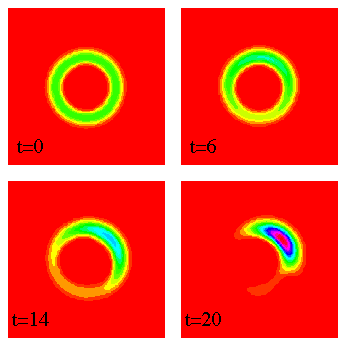 | |
| Figure 2. Starting up the quantum engine. Initial ring-like distribution at t=0 is gradually scraped up by the external field (t=6, t=14) into a well localized electron (t=20) which moves around the nucleus [4]. | |
The great thing about a quantum particle is that its wave nature allows it to 'split' into two pieces, and these can exist at two different places at the same time [5]. This can also be done with Trojan states, providing that the circularly polarized field is replaced by a linearly polarized one and providing that the initial state is equally composed of both m=ħl components. In that case the driven electron behaves like an engine that is quite difficult to imagine in a classical world - it becomes an engine with two rotors. They have a common axis but they rotate in opposite directions. As a result a strong interference pattern appears twice each period of the field oscillation, as shown in Fig 3. This is analogous to the situation in the Aharonov-Bohm experiment, and if we expose this atom to magnetic flux the interference pattern will also be shifted. The shift of the interference is drawn in Fig 4, which shows how the angular distribution of the atom changes with the magnetic flux as the flux grows.
| | |
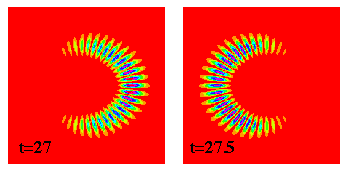 | |
| Figure 3. Self interfering atom. When two quantum 'rotors' collide a strong oscillatory pattern appears in the electron angular distribution every half of a period of the rotation. | |
| | |
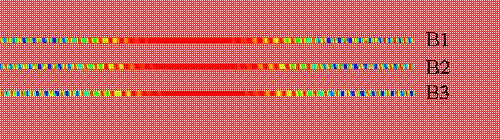 | |
| Figure 4. Angular electron distribution at a fixed distance from the nucleus for three different values of the magnetic flux B1, B2 and B3. The interference pattern shifts to the right as the flux grows. | |
The essential advantage of our novel 'laboratory' for the AB effect is that the interference repeats over many orbital periods and the phase difference accumulates. This means that we would be able to make an experiment with an electron having the coherence quality of a single atom but moving over many orbits and therefore effectively over a macroscopic distance. These are conditions impossible to obtain in a macroscopic electron interference experiments.
[1] Y. Aharonov and D. Bohm, Phys. Rev. 115, 485 (1959).
[2] I. Bialynicki-Birula, M. Kalinski and J. H. Eberly, Phys. Rev. Lett. 73, 1777 (1994); M. Kalinski, J. H. Eberly, and I. Bialynicki-Birula, Phys. Rev. A 52, 2460 (1995).
[3] I. Amato in Science 273, 308 (1996).
[4] M. Kalinski and J. H. Eberly, Phys. Rev. A 53, 1715 (1996).
[5] M. W. Noel and C. R. Stroud, Jr., Phys. Rev. Lett. 75, 1252 (1995).