 Sir Isaac Newton and the
 Sir Isaac Newton (1642-1727) was by many standards the most important figure in the development of modern science. Many would credit he and Einstein with being the most original thinkers in that development.
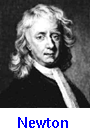 Newton's accomplishments were of
astonishingly broad scope. For example, as a sidelight to his fundamental
contributions
in physics and astronomy, he (in parallel with Liebnitz) invented the
mathematical discipline of calculus, so if you have to take both physics and
calculus courses, you have Newton to blame!
No survey course such as this one
can possibly do justice to what Newton accomplished. The poet Alexander
Pope was moved to
pen the lines
Newton's accomplishments were of
astonishingly broad scope. For example, as a sidelight to his fundamental
contributions
in physics and astronomy, he (in parallel with Liebnitz) invented the
mathematical discipline of calculus, so if you have to take both physics and
calculus courses, you have Newton to blame!
No survey course such as this one
can possibly do justice to what Newton accomplished. The poet Alexander
Pope was moved to
pen the lines
Nature and Nature's lawsand a study of Newton's discoveries suggests that Pope was indulging only slightly in hyperbole. We shall concentrate on three developments of most direct relevance to our discussion: (1) Newton's Three Laws of Motion, (2) the Theory of Universal Gravitation, and (3) the demonstration that Kepler's Laws follow from the Law of Gravitation.
lay hid in night;
God said, Let Newton be!
and all was light
Newton changed all of that. First, he demonstrated that the motion of objects on the Earth could be described by three new Laws of motion, and then he went on to show that Kepler's three Laws of Planetary Motion were but special cases of Newton's three Laws if a force of a particular kind (what we now know to be the gravitational force) were postulated to exist between all objects in the Universe having mass. In fact, Newton went even further: he showed that Kepler's Laws of planetary motion were only approximately correct, and supplied the quantitative corrections that with careful observations proved to be valid.
 Next
Next
 Back
Back
 Top
Top
 Home
Home
 Help
Help