Current Projects
Triggering A Climate Change Dominated "Anthropocene": Is It Common Among Exocivilizations?
Supervisors: Prof. Adam Frank and Dr. Jonathan Carrol-Nellenback
January 2019 - March 2021
Coupled a 1D Energy Balance Model written in Fortran to a modified predator prey model to investigate the theory that Anthropocenes are common among intelligent civilizations. In this way we ask if "Anthropocenes" of the kind humanity is experiencing might be a generic feature of planet-civilization evolution. In this study we focus on the effects of energy harvesting via combustion and vary the planet's initial chemistry and orbital radius. Of course, the evolution of coupled planetary systems - the geospheres - is highly complex. In principle it should be treated in 3D using something like a Global Climate Model and includes many processes and actors such as oceans and multiple biospheric feedbacks. The computational expense of such an approach, however, would limit the range of models we could explore. Thus the current study is meant to make a meaningful step forward in modeling technosphere/geosphere co-evolution by making specific assumptions about energy harvesting modalities and their feedback while using a simpler 1D EBM to represent climate evolution.
E. Savitch, A. Frank, J. Carrol-Nellenback, J. Haqq-Misra, A. Kleidon, and M. Alberti, Triggering a Climate Change Dominated "Anthropocene": Is It Common Among Exocivilizations?, The Astronomical Journal, vol.162, no.5, 2021, p.196, https://doi.org/10.3847/1538-3881/ac1a71
A poster summarizing our progress was presented at the 2020 TechnoClimes meeting.
This work formed the basis for my senior thesis. (Updated: July, 2021)
Improving the Probability Distribution of Interstellar Probes in a Galactic Context
Supervisors: Prof. Adam Frank and Dr. Jonathan Carrol-Nellenback
March 2020 - Current
Improving their model for the settlement of a galaxy by space-faring civilizaitons by making variables such as the settlers probe ranges/velocities normally distributed rather than constant. This was accomplished with the introduction of a local variable, technology, which we let scale exponentially with the probe's specific kinetic energy, while including relativistic corrections. It was then normalized with the aid of an Ornstein-Uhlenbeck process, a stationary Gauss-Markov process that allows a system’s technological capabilities to increase or decrease every timestep, while imposing a constant drift back to the mean, allowing the probe launches to constitute a random walk. Since then we have been running parameter sweeps of technology and its related rates in order to get charts of trajectories, phase diagrams of final values, and most recently to extract the radial dependence on technology within our models.
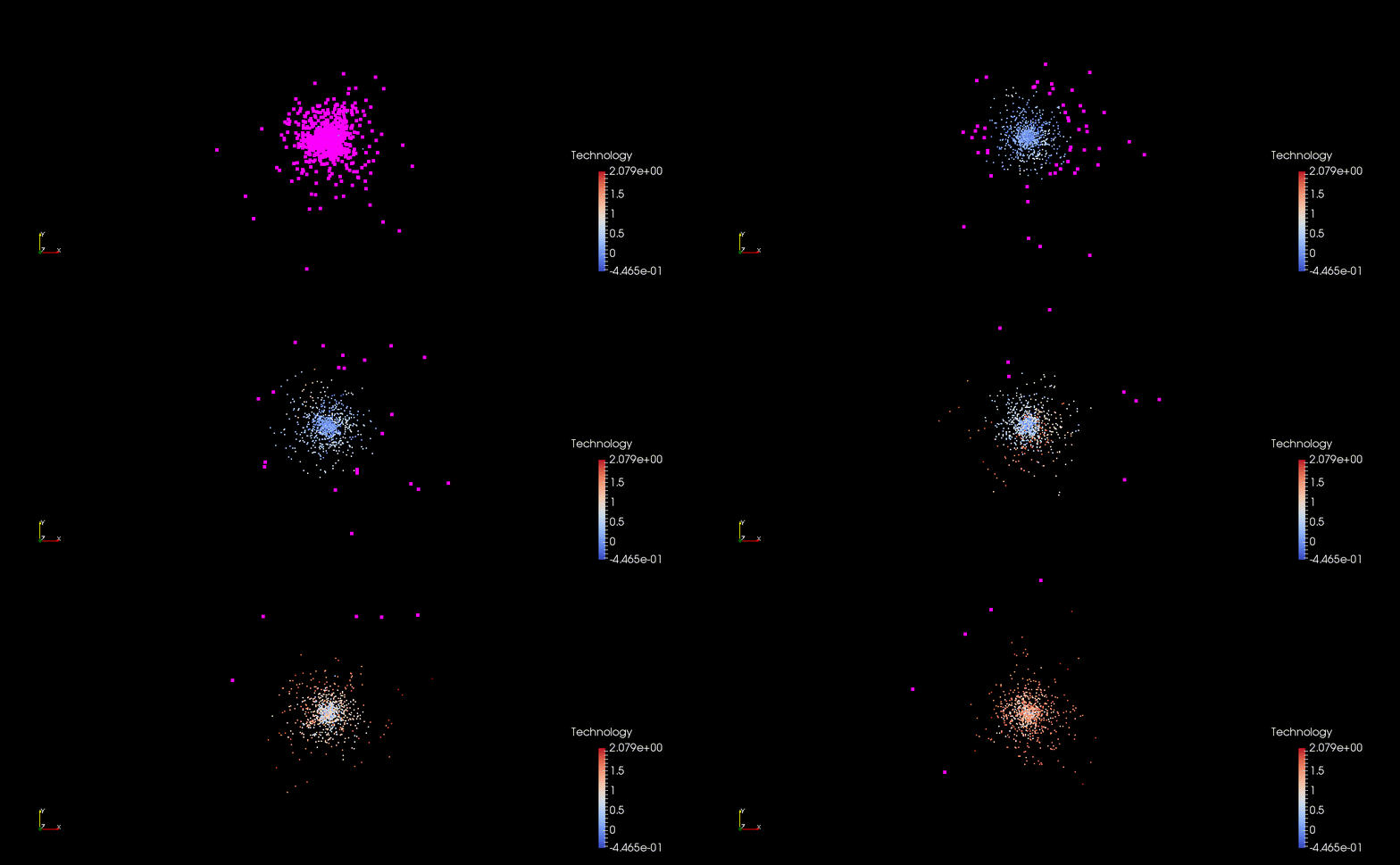 Figure: The above gif shows the temporal evolution of a model galaxy. The simulation starts with 10 habited solar systems, called abiogensis seeds. These systems send probes out to nearby systems, thus making those systems inhabited and repeating this process until the entire galaxy is filled with life. The uninhabited systems are shown as the pink boxes. Note that a selection effect results in the systems on the outer edge of the galaxy gaining high technological abilities before systems near the center.