Eric Mamajek
Assistant Professor
Dept. of Physics and Astronomy
University of Rochester

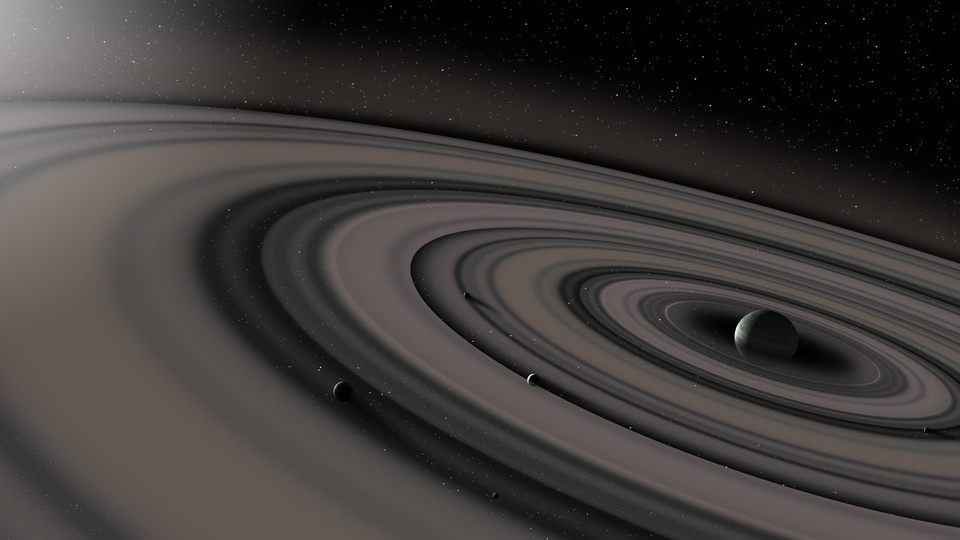
Artist's conception of J1407 eclipsing ring system by Ron Miller
Physics & Astronomy Department
UR Physics & Astronomy Major & Minor and Graduate Program
UR Physics & Astro Visitor's Info
Mees Observatory Summer Tours

AST 241: Astrophysics I (Stellar) (Spring 2013)

Curriculum Vitae, Press, Stellar Color/Teff Table, MK Spectral Type Notes, Notes on the Sun
Publications: Google Scholar, sorted by # of citations, 1st-author only sorted by # citations,
sorted by date, astro-ph submissions, IAU 258 (The Ages of Stars)

Recent papers:
"A Kine-Chemical Investigation of the AB Dor Moving Group 'Stream'" (Barenfeld, Bubar, Mamajek, & Young, ApJ, 766, 6)

"Planetary Construction Zones in Occultation: Discovery of an Extrasolar Ring System Transiting a Young Sun-like Star and Future Prospects for Detecting Eclipses by Circumsecondary and Circumplanetary Disks" (Mamajek, Quillen, Pecaut, Moolekamp, Scott, Kenworthy, Collier Cameron, & Parley, 2012, AJ, 143, 72)

"On the Age and Binarity of Fomalhaut" (Mamajek, 2012, ApJ, 754, L20)

"A Revised Age for Upper Scorpius and the Star Formation History among the F-type Members of the Scorpius-Centaurus OB Association" (Pecaut, Mamajek, & Bubar, 2012, ApJ, 746, 154)

"Disk Population of the Upper Scorpius Association" (Luhman & Mamajek, 2012, ApJ, 758, 31)

"A Spitzer MIPS Study of 2.5-2.0 Msun Stars in Scorpius-Centaurus" (Chen, Pecaut, Mamajek, Su, & Bitner, 2012, ApJ, 756, 133)

Eric joined the University of Rochester faculty in 2008 as an Assistant Professor in the Department of Physics and Astronomy. His primary research interests are the formation and evolution of planetary systems, stars, and stellar groups in our Galactic neighborhood. His recent and on-going research projects and collaborations involve quantifying and trying to understand the evolution of protoplanetary and dusty debris disks around normal stars, improving distance and age estimates to astrophysically interesting stellar, protostellar, substellar, and planetary systems, and surveys to image extrasolar planets and substellar companions to nearby stars in the near- and thermal infrared. He has also recently discovered a few new nearby young stellar groups in the solar neighborhood within a few hundred parsecs of the Sun, and is interested in investigating the recent star-formation history and kinematics of the solar neighborhood and what it can inform us about star-formation mechanisms. He also recently co-authored a paper on the observational consequences of protoplanet collisions, and recently codiscovered an extrasolar ring system (possibly a circumplanetary or "protoexosatellite" disk?) transiting a young Sun-like star.

Current student and postdoctoral collaborators affiliated with UR

  • Duy Cuong Nguyen: postdoc (PhD 2009 U. Toronto) - stellar spectroscopy, stellar abundances

  • Mark Pecaut: PhD student - star-formation history of nearest OB association
  • Erin Scott: PhD student - modeling transiting circumstellar and circumplanetary disks

    Past students and postdoc collaborators

  • Susana Acosta: UR class of 2012
  • Scott Barenfeld: UR class of 2012 (now PhD student in Astronomy - Caltech)
  • Matt Bourque: class of 2011 (Florida Tech) (2010 UR REU program)
  • Eric Bubar: postdoc (PhD 2009 Clemson; now assistant professor Physics - Marymount University)
  • Julieta Gruszko: UR class of 2012 (now PhD student in Physics - University of Washington)
  • Dilyana Mihaylova: UR class of 2013
  • Fred Moolekamp: UR PhD student
  • Alex Shvonski: UR MSc class of 2009 (now PhD student in Physics - Boston College)
  • Marek Slipski: UR class of 2011 (now PhD student in Astrophysical and Planetary Sciences - Univ. of Colorado, Boulder)

    On-line Material

  • Stellar links
  • Cool plots
  • Potentially useful astronomy FORTRAN codes:
    cahk.f - age-dating Sun-like stars with activity/rotation parameters (gyrochronology, Mt. Wilson S, R'HK, X-ray flux, etc.)
  • Potentially useful comments and links regarding careers in astronomy/astrophysics
  • Potentially useful statistics papers for astronomers

    EEM's Astronomy Notes and Data Tables

  • A modern mean stellar UBVIJHKs color and effective temperature (Teff) sequence for O9V-Y0V dwarf stars
  • Notes on Luminosity Class V (dwarf) and Class IV (subgiant) MK Standard Stars
  • Basic astronomical data for the Sun
  • On the distance to 2M1207
  • Helium-metal fraction slope dY/dZ: Review of recent published estimates
  • Primordial Helium abundance Yp: Review of recent published estimates
  • Mid-Infrared Extinction Law in the Spitzer IRAC (3.6-8 micron) and MIPS 24 micron Photometric Bands: A Summary of Recent Literature
  • Deriving V Magnitudes from USNO-A2.0 Photographic Photometry
  • Comparison between Bessell-Brett (1988) V-K colors and Johnson-2MASS V-Ks colors for dwarf stars, or a check on the Carpenter (2001) transformation from 2MASS Ks to BB88 K-band
  • Accurate Geodetic Coordinates for Observatories on Cerro Tololo and Cerro Pachon and the difficult-to-find 1972 Harrington study