Projects
Here are some papers/projects I have completed for various courses I have taken so far.
PHY 243W: Advanced Experimental Techniques -- Fall 2017 (Senior)
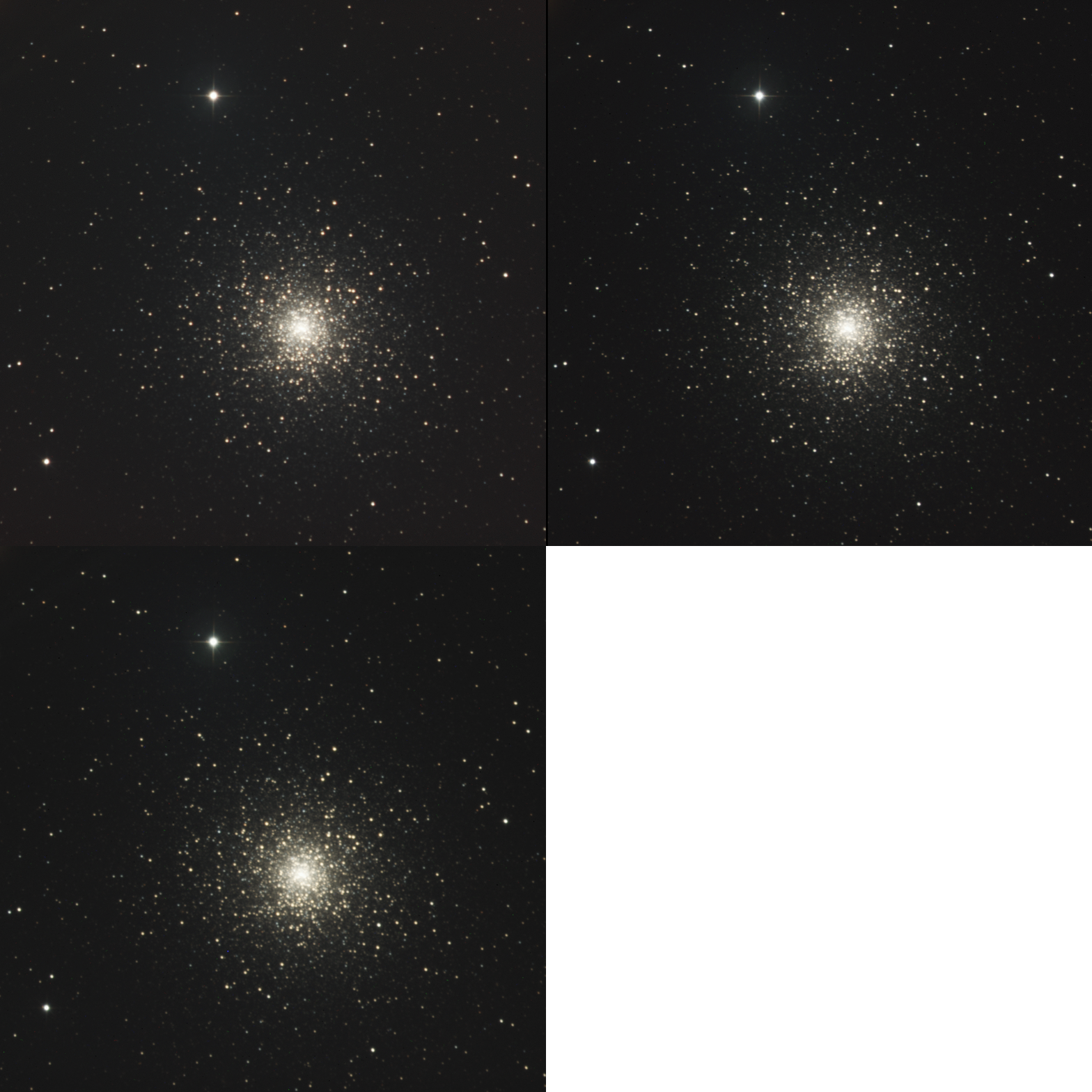
RR Lyrae Stars and Stellar Evolution in the Globular Cluster M15
We present lightcurves for 30 RR Lyrae variable stars identified in the globular cluster M15
using observations recorded at the University of Rochester’s C.E.K. Mees Observatory. The periods
of the variables are compared to observations of the brightest RR Lyrae star, RR Lyrae itself,
whose proximity is such that its distance is accurately determined by parallax measurements. From
this we estimate the distance to M15 to be 9000 ± 370 pc. Further, we perform photometry for the
stars in the cluster in three wavelength bands and present a HR diagram of M15. We discuss the
evolution of the stellar members of M15 by comparison of the HR diagram to that of nearby stars.
Here is a blinking gif
of M15 - how many variable stars can you find?
The Franck-Hertz Experiment
We conduct the classic Franck-Hertz experiment in which electrons are accelerated through a mercury
vapor and inelastically collide. We find the energy required to initiate inelastic collisions
between electrons and mercury atoms to be 4.69 ± 0.05 eV, in agreement with the lowest excited
state of mercury (63P0). The dependence of the Franck-Hertz curve on the tube temperature is
explored, and we find a decrease in average peak spacing with increased temperature. We find the
measurement of the lowest excited state to be stable with temperature if derived from minima
spacings, and inconsistent if derived from the maxima spacings, in agreement with previous studies.
PHY 413: Gravitation (Graduate) -- Spring 2017 (Junior)
Gravitational Wave Radiation by Binary Black Holes
Derivation of gravitational waves from the Einstein field equations under the
linearized theory, derivation of the quadrupole formula for energy radiated from a
system in the form of gravitational waves, equations describing gravitational wave
radiation for a binary system: power radiated, rate of orbital decay, waveform of
emitted gravitational waves. Comparison of linearized gravitational waves to the first
LIGO detection "chirp" and waveform.
PHY 235W: Classical Mechanics -- Fall 2016 (Junior)
Small Oscillations of the n-Pendulum and the "Hanging Rope" Limit n →
∞
Solving for the equations of motion and frequencies of small oscillations for a n-link
pendulum and exploring the limit in which the pendulum becomes a dangling rope of
continuous mass density. This is explored from four different approaches: using
Newtonian mechanics from a discrete setup (n-pendulum) and then taking the limit, as
well as starting with the continuous case (rope) and solving, as well as using
Lagrangian mechanics for the discrete and continuous cases. This term paper partially
satisfies the upper-level writing requirement of the Physics and Astronomy major at
UR.
Interactive Mathematica notebooks: Enter a value of n and watch the pendulum swing!
Numerical solution for full n-pendulum: npendulum.nb
Small-oscillations (fully solved): smalloscillationsnpendulum.nb
AST 142: Elementary Astrophysics -- Spring 2016 (Sophomore)
Black Hole Mergers and Gravitational Wave Astronomy
Basic concepts of gravitational wave emission from binary black holes: inspiral,
merger, ringdown phases. Basic properties of gravitational waves and their
ability to be detected, principles of gravitaitonal wave astronomy: interferometry,
noise-reduction techniques, what kind of science can be accomplished by measuring
gravitational waves, future observatories in development.
AST 111: The Solar System and Its Origin -- Fall 2014 (Freshman)
Measuring The Mass of Uranus by Observing the Revolution of the Moons Using Kepler's
Third Law
Final project involving observations from the C.E.K. Mees Observatory's 24 inch Cassegrain
telescope and 4k CCD camera. The positions of the moons and their separation from the
planet are measured in order to determine the mass of Uranus via Kepler's Third Law.
However, only three nights of data were acquired during the semester, and so fitting a
sine curve to the three data points was impossible. Instead, I develop my own method that
is able to determine an excellent approximation given the orbital geometry of the Uranus
system relative to our line-of-sight. Periods of the moons Titania and Oberon are found to
4% and 1% accuracy respectively, and the mass of Uranus is determined to 11% accuracy.
Largest sources of error come from the following assumptions: (1) the orbit of the moons
are circular and (2) the Uranus system is viewed exactly pole-on. The magic of
conservation of momentum does the rest.